Votre emplacement
Les options de livraison diffèrent selon les zones
Connectez-vous pour actualiser votre adresse
The red karate belt serves two distinct functions within Japanese martial arts, ranging from the role of official identifier (Aka) during combat and form events to that of a superior honorary rank in certain traditional styles. Designed to resist dynamic grips and the wear of regular training, the offered variations meet the technical requirements of modern karate. For practitioners progressing through the pedagogical curriculum of intermediate ranks, the selection also links with colored karate belts suitable for dojo rank testing.
Frequently Asked Questions – Red Karate Belts
[faq_container]
[faq_item question=”Quelle est la différence entre une ceinture rouge de compétition et une ceinture rouge de grade ?”]
In international sports competition governed by WKF (World Karate Federation) standards, the red belt (Aka) serves exclusively as a visual marker to designate one of the two competitors or technicians on the mat, in opposition to the blue belt (Ao). This tournament model is worn regardless of the karateka’s actual rank, including by black belts. Conversely, in the traditional progression of some schools or for very high ranks (9th and 10th Dan), the red model materializes the martial accomplishment of a grandmaster. For official events, it is essential to choose models with the conformity label described in our guide on WKF competition karate belts.
[/faq_item]
Read more (features, advice, and full description)
▼
[faq_item question=”Quelles sont les spécificités techniques entre une ceinture rouge pour le Kata et pour le Kumite ?”]
Structural requirements differ according to the discipline practiced to optimize comfort and visual rendering:
Kata-dedicated models: These belts generally feature a greater width (4.5 cm to 5 cm), reinforced thickness in heavy cotton or satin finish, and a dense weave offering a rigid hold with a perfect hang during stances.
Kumite-focused models: Designed for mobility and speed of execution, they feature a classic width of 4 cm to 4.2 cm, immediate flexibility, and a lightened structure facilitating a solid tightening that does not come undone during explosive movements.
[/faq_item]
[faq_item question=”Comment déterminer la longueur idéale et entretenir une ceinture rouge ?”]
The choice of length and maintenance require a precise protocol to preserve the textile structure:
Size calculation: Multiply your waist circumference by two, add approximately 100 cm to 110 cm for the knot, and allow each end to hang 20 to 30 cm below the knot, without extending past the bottom of the karate-gi jacket.
Cleaning and preservation: Absolutely avoid hot machine washing to prevent red dye bleeding and shrinkage of the cotton inner core; prefer airing in the shade or localized hand washing with cold water.
[/faq_item]
[faq_item question=”Que faire si la ceinture rouge glisse ou se dénoue constamment durant l’assaut ?”]
Common problem: A new red belt, particularly in satin finish or unsoftened heavy cotton, tends to slip or have its knot quickly loosen under the effect of hip rotations and impacts.Solution: Slightly dampen the knot area during the first uses to tighten the textile fibers, or adopt the traditional locked flat knot (crossed competition knot inside). To verify the exact correspondence of measurements and thickness according to your body type, consult the detailed technical recommendations on the karate belt length by size and age page.
[/faq_item]
[/faq_container]
Material requirements and selection criteria for the red belt
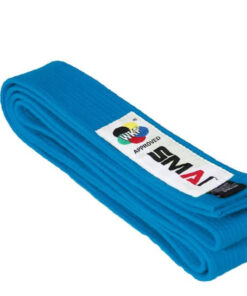
Choosing a red belt is done in accordance with refereeing constraints and the type of practice envisioned in combat areas. Models made in Japan or by reputable brands offer multi-layer weaving ensuring excellent durability without premature discoloration on the white fabric of the jacket. During championships, this piece of equipment is used in strict alternation with blue karate belts to materialize the official corners assigned by the judges. Competitors concerned with the visual impact of their technical sequences can analyze the specific rigidity criteria listed in the guide dedicated to Kata competition karate belts. A rigorous selection of fabric density guarantees impeccable stability of the martial garment during technical execution.
To complete your equipment, discover the reference model SHUREIDO Kata Red or Blue Cotton Karate Competition Belt – WKF, as well as our complete guide on the Karate Belt FAQ.